Public network water is called potable water, meaning it is considered safe for human consumption. To achieve this, it must meet microbiological, physical, chemical, and radioactive criteria established by public health regulations set by the WHO, European Union, and the Directorate-General of Health. However, there are two very important caveats: 1) in the process of disinfecting water with chlorine, disinfection by-products are generated that are toxic — trihalomethanes — whose toxicity, even at low concentrations, may have health consequences due to accumulation; 2) the number of new chemical products created worldwide has been increasing rapidly. It is currently estimated that 15,000 new substances are registered daily in the CAS (Chemical Abstracts Registration) — these new substances are not covered by any international regulations, as that would be impossible. Whatever their intended use, part of these substances or their by-products will end up in the environment (water, air, or soil), so the number and diversity of xenobiotics (artificially synthesized substances that can appear in the environment, contaminating biological systems) has been growing exponentially.
Absolutely everything that enters our body will affect our health, either positively or negatively. Water is the body’s main nutrient and essential to all our cells. Whatever enters with the water will either: be retained by one of the body’s filters (liver, kidneys, and lungs), deposit in a particular organ, or interact directly with our cells affecting their functions.
From all this, it is clear how important it is to filter the water we drink and cook with, to ensure that our body is protected from unwanted substances carried by the water.
Some groups of substances that tap water may contain and that are harmful to our health in the medium or long term are: trihalomethanes (formed by the contact of chlorine with organic matter in the water); endocrine disruptors (found in plastics and many petroleum-derived substances); hydrocarbons (seeping into the soil from forest fire areas); pesticides; and heavy metals (aluminium, arsenic, chromium, mercury, nickel, among others). With this in mind, there is no doubt about the importance of drinking filtered water.
What Is Filtered Water?
Filtered water is water that has undergone a process to remove various constituents it contains — whether microbiological, physical, chemical, or radioactive — making it cleaner, purer, and safer for consumption. Filtration is important both for public supply water and for water from private capture systems. There are various filtration systems with different features depending on what is intended to be removed, such as: sand and other sediments, microplastics, microorganisms, chlorine by-products, pesticides, heavy metals, etc.
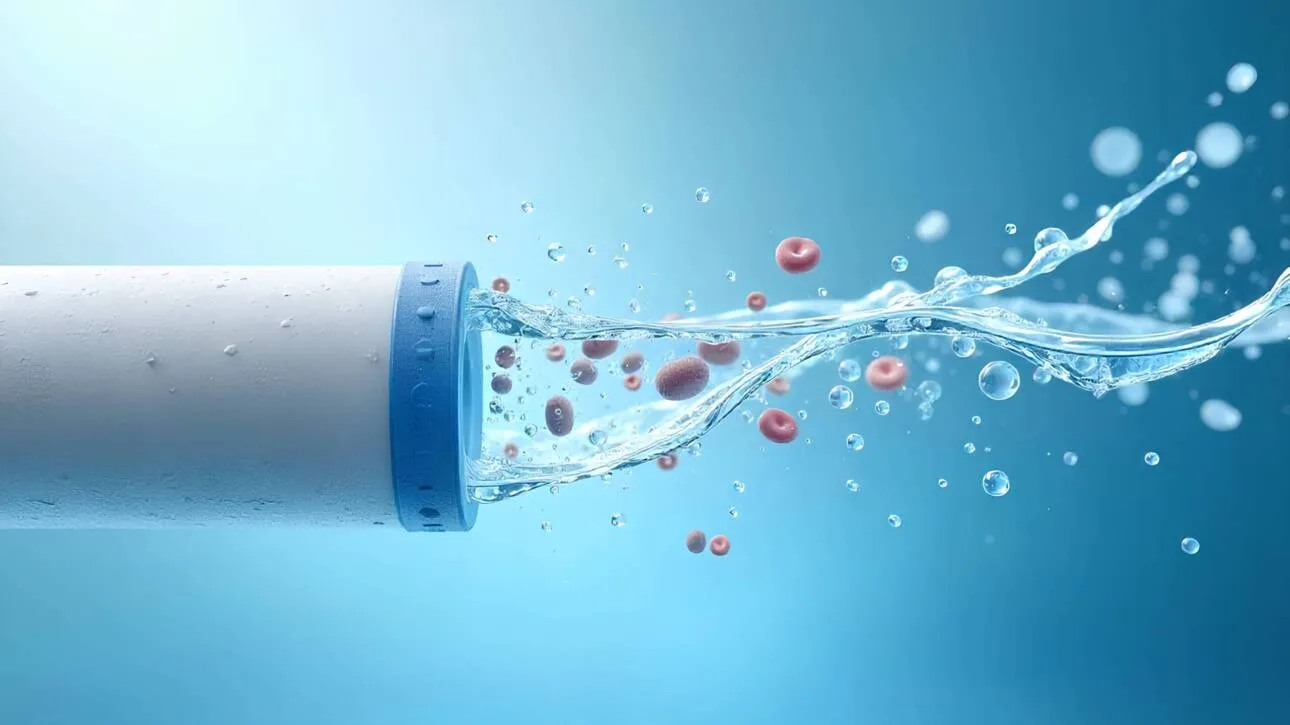
There are several filtration systems. The simplest is mechanical filtration, which uses materials like compressed cotton or polypropylene fibres to retain small particles suspended in the water. Another well-known method is the use of activated carbon, which helps eliminate chlorine and reduce unpleasant odours and tastes. When the goal is to reduce water hardness — caused by minerals such as calcium (limescale) — ion exchange is used. There’s also a less commonly mentioned but very effective technology known as KDF (Kinetic Degradation Fluxion), which can retain heavy metals and also inhibits bacterial growth within the filter. Lastly, there is reverse osmosis, the most effective water purification technique, as it uses a semipermeable membrane to remove the smallest chemical impurities that other methods cannot eliminate. It is therefore clear that there are various categories of filtered water.
Benefits of Filtered Water for the Body
The benefits of drinking filtered water are numerous. It’s important to start by understanding that whatever enters our body is only useful if it consists of nutrients the body needs for its functions, such as: water, vitamins, minerals, plant fibres, proteins, and quality fats. Everything else that may enter is potentially harmful, as it consumes resources for its elimination, can interfere with various bodily functions, and often becomes retained in certain organs — especially the kidneys, liver, and brain. Once retained, it has a cumulative harmful effect over time, potentially causing anything from mild imbalances to the development of diseases. Although the chlorination of tap water kills most microorganisms, filtered water also serves as an effective protective barrier against these agents.


The benefits of drinking filtered water are numerous, especially when compared to the countless potential health risks of drinking water that contains toxic substances — even if these are within the legally established limits. Thus, in the medium or long term, and depending on individual sensitivity, some of the following health imbalances may potentially arise due to certain groups of chemicals that may be present in the water:
Trihalomethanes – toxic to the kidneys and liver, with anti-estrogenic (hormonal) effects and carcinogenic potential (linked to bladder and rectal cancer).
Endocrine disruptors – act like hormones and may interfere with reproductive and internal regulatory processes, such as: menstrual cycle irregularities, fertility issues, male feminisation, reproductive system cancers, among others.
Hydrocarbons – liver and kidney toxicity, neurological disorders, hormonal dysfunctions, immune effects, and carcinogenic potential (leukaemia).
Heavy metals (lead, mercury, cadmium, arsenic, and others) – liver and kidney toxicity, neurological alterations, osteoporosis, skin disorders, cardiovascular problems, and carcinogenic effects.
Pesticides – respiratory, neurological, hormonal (endocrine-disrupting), immune system effects, and carcinogenic risks.
Drinking filtered water, from which most harmful substances have been removed, is not only a preventive measure against all the imbalances and diseases that could result from these contaminants, but it also supports better functioning of the kidneys, liver, digestive system, and overall bodily systems. Moreover, it is lighter water with a more pleasant taste, making it more enjoyable to drink and enhancing the natural flavour of teas and soups. Many people report feeling more energetic and less “heavy,” likely due to the reduced exposure to harmful substances. There are also visible benefits — the skin often improves in texture and hydration, especially in people sensitive to chlorine, and hair may become softer and less brittle.
Conclusion
Drinking filtered water is a responsible and safe choice, and one of the most important preventive measures against many health imbalances and diseases potentially triggered by chemicals found in unfiltered water. It is also a way of choosing greater physical well-being and vitality, as it helps the body function more efficiently.
We all want to be long-lived — that is, to live more years with health and energy — and this is possible if we adopt healthy lifestyle habits, starting with what we put into our bodies. Using filtered water is, therefore, a preventive investment in health over the medium and long term. For those seeking well-being through natural means, starting by taking care of the quality of the water they consume is a smart, logical, and highly beneficial step.


Bibliography
- Vera, J., Fernandes, V., Correia-Sá, L., Mansilha, C., Delerue-Matos, C., & Domingues, V. (2021). Occurrence of selected known or suspected endocrine-disrupting pesticides in Portuguese surface waters using SPME-GC-IT/MS. Separations, 8(6), 81. https://doi.org/10.3390/separations8060081
- Gonsioroski, A., Mourikes, V. E., & Flaws, J. A. (2020). Endocrine Disruptors in Water and Their Effects on the Reproductive System. International Journal of Molecular Sciences, 21(6), 2020 March. https://doi.org/10.3390/ijms21061929
- Rocha S, Domingues VF, Pinho C, Fernandes VC, Delerue-Matos C, Gameiro P, Mansilha C. Occurrence of bisphenol A, estrone, 17β-estradiol and 17α-ethinylestradiol in Portuguese rivers. Bull Environ Contam Toxicol. 2013 Jan; 90(1):73-8. https://doi.org/10.1007/s00128-012-0887-1
- Mansilha, C., Melo, A., Ferreira, I. M., Pinho, O., Domingues, V., Pinho, C., & Gameiro, P. (2011). Groundwater from infiltration galleries used for small public water supply systems: Contamination with pesticides and endocrine disruptors. Bulletin of Environmental Contamination and Toxicology, 87(3), 312–318. https://doi.org/10.1007/s00128-011-0337-5
- Mansilha, C., Silva, P., Rocha, S., Gameiro, P., Domingues, V., Pinho, C., & Ferreira, I. M. (2013). Bisphenol A migration from plastic materials: Direct insight of ecotoxicity in Daphnia magna. Environmental Science and Pollution Research, 20(9), 6007–6018. https://doi.org/10.1007/s11356-013-1614-0
Note
Regarding the growing increase in synthetic chemical products — which may eventually contaminate water, soil, and air — the following chart may be of interest (I believe a more up-to-date version has not been created, at least I couldn’t find one), along with the accompanying information.
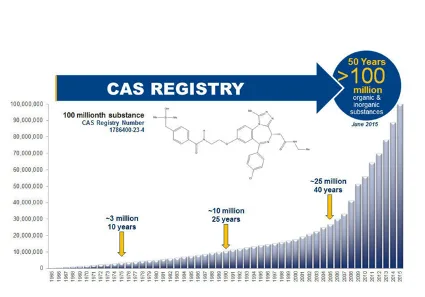
In the CAS Registry (Chemical Abstracts Registration), from 1965 to 2015, 100 million chemical substances were registered, with an average of 1,500 new substances registered per year. At that time, it was estimated that around 500 tonnes of chemicals were produced annually on the planet. Of these, less than 10% had been studied for their toxic effects on developing organisms.
By 2025, the number of registered unique chemical substances — including organic and inorganic compounds, polymers, alloys, minerals, proteins, nucleic acids, and other biological sequences — had risen to 279 million. Although the exact number may vary, it is estimated that approximately 15,000 new substances are added each day, totalling around 5.5 million per year.